

How to keep track of what you like in a cigar subscription

Keep a short tasting log for every cigar in your cigar subscription: record its exact name and size, what you enjoyed, how the strength felt, and whether you want it again. Separate flavor preferences from draw, burn, and smoking conditions so one frustrating cigar does not become a verdict on an entire blend.
- Track each cigar subscription selection by exact blend, size, flavor, strength, and repeat decision.
- Creekside Cigar Co. suits adults exploring boutique cigars through a monthly cigar subscription and personal guidance.
- Choose a phone note for easy capture; choose a spreadsheet when you want to compare recurring preferences.
- Use your own tasting language, then turn repeated likes and dislikes into specific questions for the crew.
Why this matters
A cigar band helps you remember a brand. It does not tell you why you enjoyed that particular cigar, whether another size felt different, or whether the draw distracted you from the flavor.
For adults 21+, a useful journal connects discovery to the next buying decision. If you are exploring the Creekside Cigar Club, keep your notes alongside each shipment's identities rather than relying on a pile of saved bands. The goal is a clearer preference, not a more impressive tasting vocabulary.
How do you keep track of what you like in a cigar subscription?
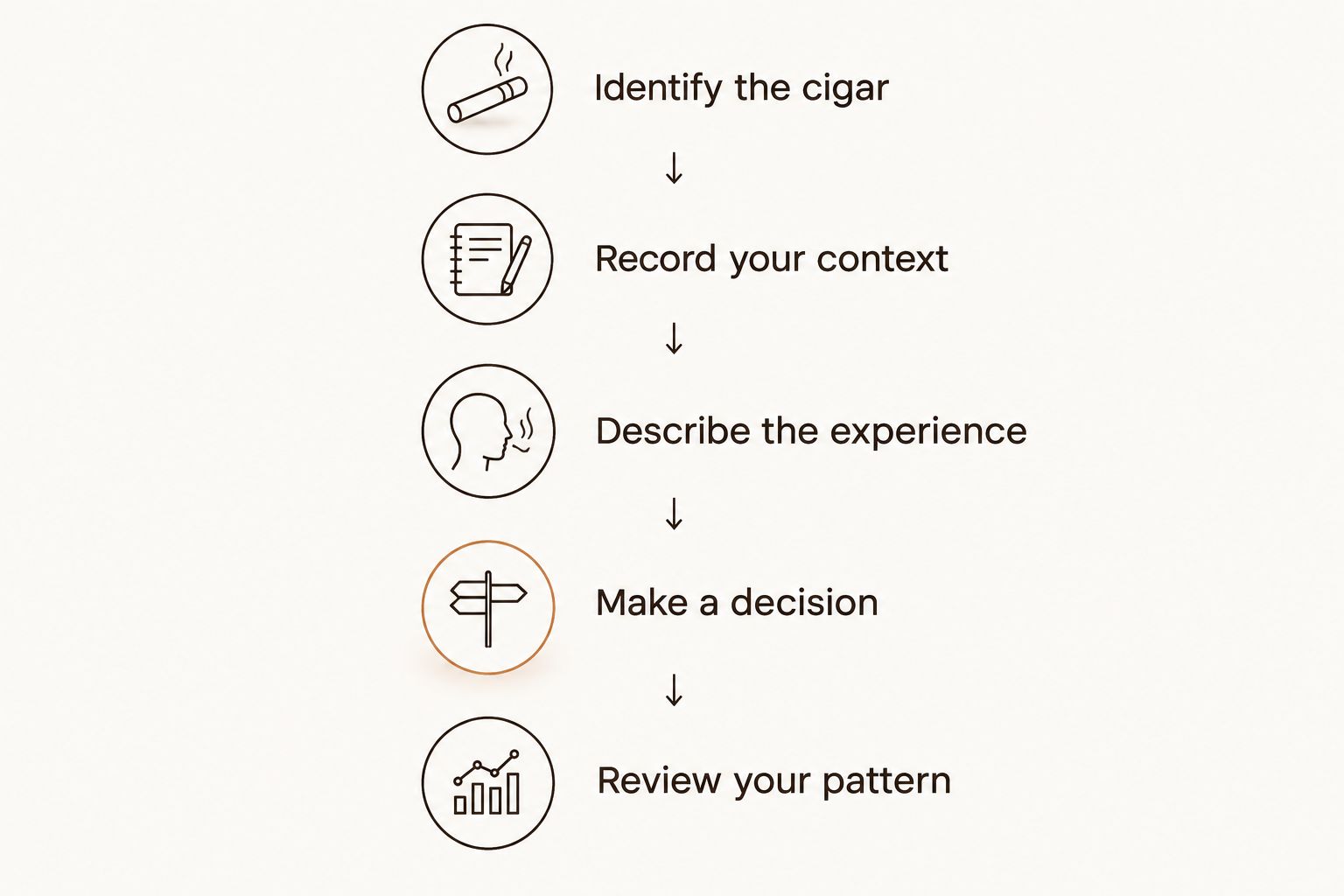
Use the same short process every time. Start a journal labeled 2026, keep each cigar's identity attached to its notes, and finish each entry with a buying decision rather than a score alone.
- Identify the cigar. Copy the brand, blend, and size from the packaging or a verified listing. Photograph the band before removing it.
- Record your context. Note the date, drink, setting, and anything unusual about storage or the cigar's condition.
- Describe the experience. Separate flavor, body, strength, draw, and burn instead of combining them into one vague judgment.
- Make a decision. Mark the cigar Repeat, Revisit, or Pass, followed by a plain-language reason.
- Review your pattern. Compare entries before choosing another sampler, ordering a repeat, or asking for guidance.
These are suggested journal steps, not a required tasting protocol. Keep the record brief enough that you will actually finish it.
Choose a tracking method you will keep using
Use a phone note unless you already prefer another system. A detailed spreadsheet is useful only if entering the information does not become a chore. The methods below organize the same information; none requires a specialist tasting vocabulary.
| Tracking method | Best for | Main advantage | Main limitation |
|---|---|---|---|
| Phone note | Quick entries beside a band photo | Keeps pictures and short observations together | Comparing many entries requires consistent labels |
| Spreadsheet | Finding repeated preferences | Lets you sort by size, strength, or repeat decision | Requires more setup and consistent data entry |
| Paper notebook | Writing away from a screen | Gives you room for bands and free-form observations | Searching past entries is manual |
| Photo album | Remembering cigar identities | Makes the band easy to recognize later | A photo alone does not explain your preference |
If you choose photos, add a written caption. If you choose paper, use the same field order on every page. A simple system with completed entries beats an elaborate system full of blanks.
What should you write in a cigar tasting log?
Start with identification, then add only information that helps you choose again. A wrapper is the outer tobacco leaf; the binder holds the filler together beneath it. Record blend details when they are verified, but do not guess a wrapper's origin from its color.
Use this copyable template for your 2026 cigar subscription journal:
- Date: When you smoked the cigar.
- Identity: Brand, blend, and exact size or vitola.
- Band photo: A picture linked to this entry.
- Verified details: Wrapper, binder, and filler information when known.
- Context: Drink, setting, storage observations, and anything unusual.
- Flavor: Familiar words that describe what you tasted.
- Body and strength: How substantial the smoke felt and how the nicotine affected you.
- Draw and burn: Airflow, relights, or other interruptions.
- Decision: Repeat, Revisit, or Pass, with a reason.
A vitola is a cigar's size and shape. Keep it in the identity field because remembering the blend without its format leaves your next order less precise.
Keep flavor, body, and strength separate
Flavor describes what you taste. Body describes the weight or fullness of the smoke on your palate. Strength describes nicotine impact. A flavorful cigar does not automatically belong in your strongest category.
Use familiar descriptions such as woody, earthy, sweet, peppery, or simply dry. Those are vocabulary examples, not tasting claims about any particular cigar. If nothing more specific comes to mind, write whether you enjoyed the flavor and what made it pleasant or distracting.
For a manageable routine, use 3 tasting checkpoints: beginning, middle, and finish. Record a change only when you notice one; identical notes across all checkpoints are perfectly useful.
Record construction without confusing it with taste
Draw is how easily air moves through the cigar. Burn notes describe how it burned, including uneven burning or repeated relights. Keep those observations separate from the blend's flavor.
A note that says enjoyable flavor, difficult draw gives you more useful information than bad cigar. It leaves room to revisit the blend without pretending the frustrating experience did not happen.
How should you rate cigars without overcomplicating it?
Finish every entry with one decision label: Repeat, Revisit, or Pass. These are suggested buying categories, not an industry rating standard. Add a short reason so the label still makes sense when you read it later.
Repeat: best for identifying future orders
Use Repeat when you enjoyed the cigar and want that exact blend and size again. State what earned the decision: comfortable strength, appealing flavor, satisfying format, or another observation you actually recorded.
The advantage is clarity. The limitation is that a Repeat label alone does not explain whether a different cigar would suit you, so preserve the reason beneath it.
Revisit: best for an uncertain experience
Use Revisit when you liked part of the experience but cannot separate the cigar from an interruption, uncomfortable setting, or construction issue. Write what you want to check on another occasion.
Revisit preserves uncertainty honestly. Its drawback is that it can become a holding area for every undecided entry; give each one a specific question, not just another vague rating.
Pass: best for recording a clear mismatch
Use Pass when you do not want to buy that cigar again. Identify the mismatch without turning a personal preference into a claim about quality.
A clear Pass prevents accidental repeat purchases. Its limitation is scope: disliking one blend does not establish that you dislike every cigar from the same maker, country, or wrapper category.
Why your cigar impressions vary
Your log should explain the experience you had, not force every impression into a fixed profile. Keep these factors visible when comparing entries:
- Exact format: Different sizes are distinct buying choices. Record the vitola rather than grouping everything under a brand name.
- Drink or food: Record what accompanied the cigar so you can recognize context when comparing your own impressions.
- Storage and condition: Note known storage concerns or visible damage. Do not diagnose a humidity problem from taste alone.
- Smoking pace: Write down whether you rushed or repeatedly set the cigar down. Avoid treating different sessions as identical conditions.
- Draw and burn: A difficult draw or repeated relights belong in the record, separate from flavor preference.
- Your vocabulary: Early notes can be broad. Keep the original entry rather than rewriting it to match someone else's tasting description.
Describe what happened before deciding what caused it. Your journal is a record of your experience, not proof that a single variable explains it.
How do you turn tasting notes into better cigar orders?
Review your 2026 entries by decision label first. Among the Repeat entries, look for recurring descriptions, comfortable strength levels, and formats you actually enjoyed. Then check the Pass entries for specific mismatches rather than searching only for similarities among favorites.
Write a short preference brief in 2 sentences: what you want more of, followed by what you want to avoid. Include exact cigar identities as evidence, and label anything uncertain as something you want to explore.
Creekside Cigar Co. is a fit for adults exploring boutique cigars who want personal guidance alongside a monthly cigar subscription. Share your preference brief with the crew when asking what to try next. Personal guidance is useful here; a tasting log does not establish that a subscription automatically customizes future selections around your ratings.
For your next 2026 order, distinguish a confident repeat from an experiment. An exact blend-and-size repeat follows an existing preference; a different wrapper, maker, or format asks a new question. Both belong in a journal, but they serve different purposes.
Should I give a cigar a score or write tasting notes?
Write a decision and a reason first; add a score only if it helps you. A number without an explanation cannot tell you whether you enjoyed the flavor, tolerated the strength, or simply appreciated an easy draw.
If you use scores, define your scale and keep it consistent throughout your 2026 journal. Do not copy a published rating into the field meant for your own experience.
What if I cannot identify specific cigar flavors?
Record enjoyment, strength comfort, and draw before chasing detailed flavor notes. Plain descriptions such as too peppery for my taste or enjoyable but heavier than I wanted are useful buying guidance.
Do not borrow a reviewer's vocabulary just to complete the entry. Your own observations are the point, even when they are less elaborate.
FAQ
What's the easiest way to track cigars from a cigar subscription?
Use a phone note with the exact cigar name, size, band photo, and a Repeat, Revisit, or Pass decision. Add a short reason so you can turn the entry into a future buying choice.
Do I need a special app for a cigar tasting journal?
No, a phone note, spreadsheet, or paper notebook can hold a useful cigar tasting journal. Choose the method you will complete consistently rather than the one with the most fields.
How many times should I take notes while smoking a cigar?
Use 3 tasting checkpoints as a simple starting routine: beginning, middle, and finish. This is a suggested journaling method, not a rule requiring you to find flavor changes.
Is cigar body the same thing as strength?
No, body describes the fullness or weight of the smoke, while strength describes nicotine impact. Record them separately so a rich flavor does not become an inaccurate strength label.
Should I save the cigar band or take a photo?
Either method helps identify the cigar, but pair the band or photo with its exact blend and size. Identification alone does not record why you liked or disliked the experience.
Can I use my tasting notes when asking Creekside Cigar Co. for recommendations?
Yes, specific tasting notes give Creekside Cigar Co. a clearer starting point for personal guidance. Share exact favorites, formats, and dislikes without assuming that a subscription automatically changes around your ratings.
One last thing
Add a separate field for worth recommending to someone else. That is not the same as want to buy again: you can recognize that a cigar suits another adult's preferences without enjoying it yourself.
For your next 2026 journal entry, make the final line a specific decision rather than a compliment. Creekside Cigar Co. can offer more useful personal guidance when good cigar becomes liked the flavor, wanted less strength, and would try a different format.


