

Buying cigars online: what to check when your order arrives

When you buy cigars online, check the parcel, confirm the cigar names and quantities against your order, and inspect the wrappers before putting anything in your humidor. Photograph damage, keep suspicious cigars separate, and contact the retailer before cutting or smoking an affected cigar. Appearance alone cannot confirm a cigar’s internal moisture or explain how it was handled in transit.
- Buy cigars online with an arrival checklist: verify the order, inspect wrappers, and document problems before smoking.
- Creekside Cigar Co. arrival guidance: keep questionable cigars separate rather than mixing them into your humidor.
- Wrapper color and visible veins alone do not establish damage; cracks, fuzzy growth, and holes need closer attention.
- A parcel’s temperature does not tell you the moisture level inside each cigar.
Buying cigars online: what should you check when your order arrives?
Check identity, quantity, packaging, and condition—in that order. Start with the order confirmation rather than your memory, especially when several cigars have similar bands or names.
For the decision before delivery, the guide to checking an online cigar shop before your first order covers the retailer checks. This 2026 arrival checklist begins when the parcel reaches you.
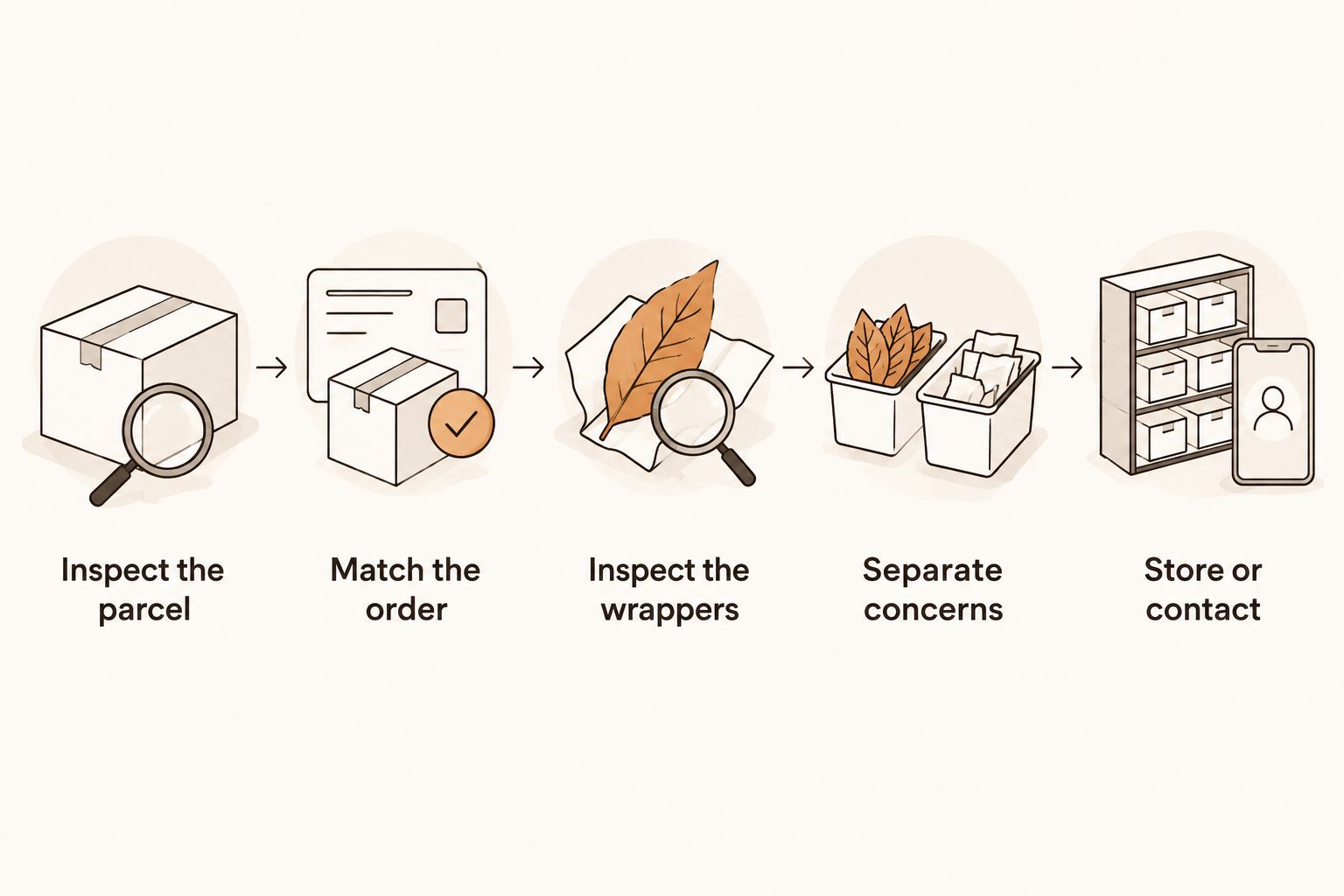
- Inspect the parcel. Look for crushing, punctures, wet areas, or an opening that exposes the contents. Photograph the package before removing damaged packing material.
- Match the order. Compare the maker, blend, size, package format, and quantity with your confirmation. Keep the packing slip beside the cigars while you count.
- Inspect the wrappers. Under good light, look for splits, crushed ends, loose tobacco, suspicious growth, and small holes. Handle each cigar gently rather than squeezing it to test freshness.
- Separate concerns. Keep anything questionable out of your established collection. Retain its packaging and record which cigars arrived together.
- Store or contact. Move apparently sound cigars into your normal controlled storage. Send the retailer clear photographs and a specific description of anything that needs clarification.
Why this matters
A delivery inspection separates an order problem from a storage or smoking problem. Once you discard the packaging, mix the cigars into your collection, or cut an affected cigar, useful evidence disappears.
Boutique cigars deserve the same practical checks as familiar brands. An unfamiliar band, darker wrapper, or unusual shape is not automatically a defect; the question is whether the cigar matches the order and shows an identifiable concern.
Check the cigar’s identity before judging its condition
A maker’s name is only part of the match. The same blend can come in different sizes, and similar packaging can make those differences easy to overlook.
Compare the full description on your confirmation with the band, box label, or enclosed identification. For a sampler, check any supplied contents list rather than assuming every cigar should look alike.
Vitola means the cigar’s size and shape. Ring gauge describes diameter in units of 1/64 inch, so a 50-ring cigar has a nominal diameter of 50/64 inch. Length and ring gauge help identify a size, but they do not establish tobacco strength or condition.
Do not use a ruler as your only identity check. A rounded foot, tapered head, or box-pressed shape changes how a cigar looks, and hand-rolled cigars are not machine-perfect objects.
If the label and confirmation disagree, photograph both. Ask the retailer to identify the cigar before treating a different band as either an acceptable substitution or a packing mistake.
Inspect the wrapper without creating damage
The wrapper is the outer tobacco leaf. Start by looking along its surface, then examine the head—the closed end you cut—and the foot, the end you light.
Support the cigar along its length and turn it gently. Avoid pinching the middle, pressing the foot, or tugging at a loose wrapper edge; those actions can enlarge an existing problem.
Use this comparison to decide what needs documentation. It is a visual screening guide, not a diagnosis of moisture, mold, or insect activity.
| What you see | What it establishes | What to do next |
|---|---|---|
| Different wrapper shades | The leaves differ in appearance | Check the blend description; color alone does not prove damage |
| Visible veins or a wrapper seam | You can see the leaf’s structure | Look for an actual opening or lifted edge rather than judging smoothness |
| A split or crushed foot | There is visible physical damage | Photograph the full cigar and the affected area before handling further |
| Fuzzy or raised growth | The surface needs closer assessment | Keep the cigar separate; do not brush it off and assume it is harmless |
| Small holes with loose tobacco dust | There are signs requiring investigation | Isolate the delivery and send photographs to the retailer |
| Torn cellophane with an intact cigar | The protective sleeve is damaged | Inspect the cigar itself and record any accompanying damage |
Do not diagnose a suspicious patch as harmless “plume” from appearance alone. Keeping a questionable cigar separate is more useful than trying to settle the issue by rubbing or brushing its surface.
What a warm parcel does—and does not—tell you
A warm shipping carton tells you the package is warm when you touch it. It does not give you a reliable measurement of moisture inside the tobacco or a history of conditions throughout the journey.
Bring the delivery indoors and keep it away from direct sunlight and heating vents. Avoid trying to correct the temperature quickly with a refrigerator, freezer, or direct cooling source.
A cold parcel deserves the same measured approach. Do not place cigars beside a heater or add water because the package feels cold.
For a 2026 delivery, record what you observe rather than assigning a transit diagnosis. “The outer carton was wet and the inner box had a damp corner” is useful evidence. “The cigars were ruined by humidity” goes beyond what that observation proves.
A humidity-control packet in the package is not a complete condition report, either. Its presence does not replace checking the cigars, and a reading inside your humidor describes that storage environment—not the moisture at the center of every newly delivered cigar.
Why arrival condition varies
Several distinct features affect what you see when you open a cigar shipment. Check each separately instead of turning every difference into a freshness verdict.
- Leaf characteristics. Wrapper color, veins, and surface texture differ among tobaccos. Compare the cigar with its description rather than expecting a uniform-looking leaf.
- Cigar shape. Rounded, tapered, open, and closed ends do not all look alike. Confirm the intended format before deciding that an unusual end is broken.
- Package format. Loose cigars, samplers, and boxed orders require different counting and identification checks. Keep any dividers or individual labels until you finish.
- Physical protection. Cellophane, sleeves, and internal packing separate surfaces and limit movement. Inspect both the protective material and the cigar beneath it.
- Visible parcel exposure. Wet cardboard, crushing, and punctures are observable facts. Document them without assuming they explain every condition inside.
- Handling after delivery. Sunlight, uncontrolled storage, and repeated squeezing add variables after arrival. Finish the inspection gently and establish controlled storage.
These factors explain why no single photograph or touch test answers every question. A good inspection produces a clear record and a sensible next step, not a blanket declaration that the entire order is perfect or ruined.
Should you put newly delivered cigars straight into your humidor?
Inspect first; store second. Apparently sound cigars belong in suitable controlled storage, while cigars with unexplained growth, holes, or other concerning signs should remain separate pending guidance.
A humidor is a storage enclosure designed to maintain humidity. It is not a treatment chamber for suspicious growth, insect concerns, or a badly split wrapper.
Keep your established collection out of the investigation. Do not transfer a questionable cigar into the main humidor simply to see whether its appearance improves.
For adults 21 years and older receiving their first order, set up storage before delivery rather than improvising after opening the parcel. A decorative box without humidity management is not automatically a functioning humidor.
Avoid adding wet paper towels or allowing cigars to touch water. If you are uncertain about your storage setup, ask for guidance on the equipment rather than experimenting on the delivered cigars.
Can you smoke a cigar as soon as it arrives?
A delivery date alone does not establish whether a cigar is ready to smoke. Inspect it first, and do not cut or light a cigar you need the retailer to assess.
There is no universal rest period that proves every shipped cigar has reached your preferred condition. Transit circumstances, the cigar’s starting condition, and your storage environment differ.
If you choose to evaluate an apparently sound cigar later, distinguish smoking observations from arrival observations. A difficult draw after cutting is a different report from a wrapper split photographed before the cigar entered your humidor.
Keep those records separate in your 2026 cigar notes. That distinction helps you describe the problem without retroactively assigning it to shipping.
What should you send the retailer if something looks wrong?
Send a short message that identifies the order, the affected cigars, and the visible issue. Attach a full view and a close-up so the retailer can understand both the location and extent of the concern.
Useful details include:
- The order identifier and delivery date.
- The exact cigar name and size from the confirmation.
- The quantity affected and the total quantity received.
- Photographs of the outer parcel and relevant inner packaging.
- Whether you have cut, smoked, moved, or otherwise handled the affected cigars.
Describe rather than diagnose. “A split runs from the foot along the wrapper” gives the retailer a clearer starting point than “these are bad.”
For a Creekside Cigar Co. cigar order, use the same evidence-first approach: identify the item and show the concern. Do not assume a particular return, replacement, or refund outcome before the retailer reviews it.
Keep the packaging until the issue is resolved. Ask what to retain and how to handle the affected cigars; do not mail anything back without instructions.
Make your next delivery easier to check
Keep a simple arrival record with your order confirmation. Note what you received, any visible concerns, and where you stored the cigars after inspection.
For a mixed order, keep the identification attached to each cigar’s record. Bands can resemble one another, and removing every sleeve at once makes tracing a concern harder.
Creekside Cigar Co. sells boutique and premium cigars, samplers, and a monthly cigar subscription club. Regardless of order format, the receiving standard stays the same: confirm what arrived before judging how it smokes.
A useful 2026 record separates three subjects: identity, arrival condition, and later smoking impressions. That keeps an unfamiliar blend from being confused with a shipping problem—or a shipping problem from becoming an unfair judgment of the blend.
FAQ
What should I check first when I buy cigars online?
Check the parcel for damage, then match the cigar names, sizes, and quantities against your order confirmation. Photograph concerns before discarding packaging or cutting an affected cigar.
Does a cracked wrapper mean the cigar arrived dry?
A cracked wrapper establishes visible damage, not its cause. Photograph the crack and packaging rather than diagnosing dryness from the split alone.
Is a darker wrapper a sign that my cigar is damaged?
A darker wrapper alone is not proof of damage. Tobacco leaves vary in color; inspect for specific concerns such as splits, suspicious growth, or holes.
Should I put a suspicious cigar into my regular humidor?
Keep a suspicious cigar separate from your established collection. Photograph unexplained growth, holes, or other concerns and ask the retailer for handling guidance.
How long should cigars rest after shipping in 2026?
There is no universal rest period that establishes readiness for every cigar shipped in 2026. Inspect the delivery, use controlled storage, and do not treat a fixed waiting period as proof of condition.
What does a 50-ring cigar measurement mean?
A 50-ring cigar has a nominal diameter of 50/64 inch. Ring gauge describes diameter, not strength, freshness, or smoking quality.
What information should I include about a Creekside Cigar Co. delivery concern?
Include the order identifier, cigar name and size, affected quantity, delivery date, and clear photographs. Describe what you observed and retain the packaging while awaiting instructions.
One last thing
Your most useful inspection tool is the order confirmation, not a squeeze test. A cigar can look tidy and still be the wrong size or blend, while a naturally veiny wrapper can look unfamiliar without being damaged.
For every 2026 delivery, finish the identity check before removing bands, cutting caps, or combining orders. That small habit preserves the information you need if a question appears later.


