

Boutique cigars: does the factory tell you how they'll smoke?
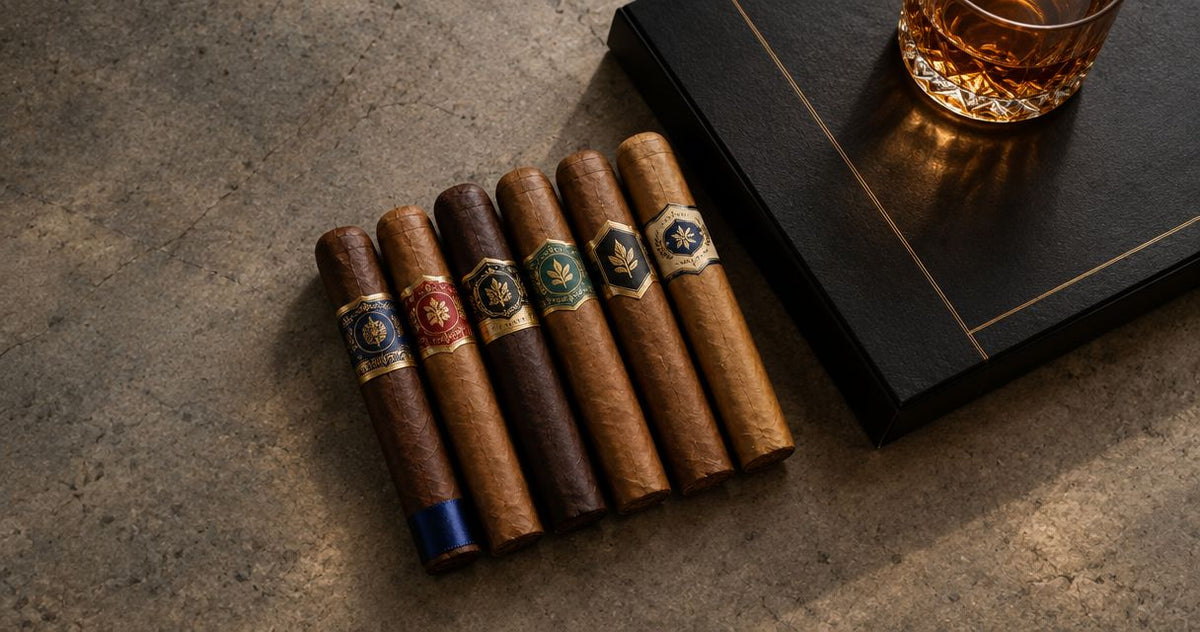
A factory name gives you useful clues about boutique cigars, but it does not tell you exactly how a cigar will taste, draw, or burn. In 2026, the better buying decision still comes from the specific blend, size, stated strength, and storage condition—not the factory name alone.
- Boutique cigars from the same factory are not necessarily similar in flavor or strength.
- Country of origin identifies where a cigar was made, not where every tobacco leaf grew.
- Compare the wrapper, binder, filler, and size before treating factory reputation as a recommendation.
- Creekside Cigar Co. serves adults exploring boutique cigars through individual selections, samplers, and a monthly Cigar Club.
Why this matters
When you recognize a factory behind a cigar you enjoyed, that connection is a useful starting point. The mistake is turning it into a promise: same factory, same experience.
A factory connection does not establish an identical tobacco recipe. Nor does it tell you whether the next cigar suits your preferred strength or format. You still need to read the individual description.
For adults 21+ exploring the Creekside Cigar Co. boutique cigar selection in 2026, the practical question is not simply who made it. It is what information supports choosing that particular cigar.
Treat factory reputation as context, not a substitute for blend information. That keeps a familiar production name from outweighing details that matter to your own preferences.
Boutique cigars: does the factory tell you how they'll smoke?
No. A factory identifies a production connection, not a fixed flavor profile. Different brands and blends made at the same facility can use different wrappers, binders, fillers, sizes, and blend proportions.
Keep three identities separate: the brand on the band, the factory that manufactures the cigar, and the countries supplying its tobacco. Those identities answer different questions.
| Information | What it tells you | What it does not establish |
|---|---|---|
| Brand | The name under which the cigar is sold | That every cigar bearing the name shares a blend |
| Factory | The stated manufacturing facility | A guaranteed flavor, strength, draw, or burn |
| Country of origin | The listed manufacturing origin | The origin of every tobacco leaf |
| Wrapper, binder, filler | The disclosed tobacco components | Exact flavor or nicotine intensity |
| Size and shape | The cigar's dimensions and format | An exact smoking duration |
| Your experience | How that cigar performed for you | How every other cigar from its factory will perform |
Factory information becomes more useful when you already know the blend details and have your own comparison point. It becomes less useful when it is the only specific fact in the description.
A missing factory name is not proof of poor construction. An impressive factory name is not proof that you will enjoy the blend. Buy the cigar described, not the reputation you attach to its maker.
What the product descriptions actually demonstrate
The product specifications used in this 2026 guide show why manufacturing origin and tobacco origin need separate columns. Neither example below names a factory in its supplied description, so neither supports a factory-level conclusion.
| Cigar | Listed specifications | Best for | Useful detail | Limitation |
|---|---|---|---|---|
| Crux Cigars Passport Super Selection 1 | Dominican Republic origin; Ecuadorian Habano wrapper; Nicaraguan binder; Nicaraguan and Honduran filler; 6-inch length, 42 ring gauge | Readers examining the difference between manufacturing origin and tobacco origin | Its listed tobacco countries differ from its manufacturing origin | The description does not establish factory identity or strength |
| Rodriguez Cigars Serie 84 Maduro Robusto | Nicaragua origin; Habano Maduro wrapper; Nicaraguan and Ecuadorian binder; Nicaraguan filler; 5-inch length, 50 ring gauge | Readers comparing a shorter, wider format with a narrower corona | The description separates wrapper, binder, filler, and size | Maduro does not establish strength, and factory identity is not stated |
These examples support a narrow conclusion: an origin label does not describe the entire blend. They do not establish which cigar tastes better, which has more nicotine, or whether either resembles something you already enjoy.
Read the blend before the factory story
The wrapper is the outer leaf. The binder holds the filler together beneath it, while the filler forms the interior tobacco blend. Read those components together rather than assigning the whole cigar's character to its wrapper.
An Ecuadorian wrapper does not make the finished cigar Ecuadorian in manufacturing origin. Likewise, a cigar made in Nicaragua can contain tobacco grown elsewhere. The product examples above make that distinction concrete.
Size deserves equal attention. Ring gauge expresses diameter in sixty-fourths of an inch, so a 50 ring gauge identifies a diameter of 50/64 inch. Length is listed separately; a 5-inch robusto and a 6-inch corona are not interchangeable formats simply because both carry a familiar brand name.
Do not turn dimensions into a promised smoking time. Your pace and the cigar's combustion affect how long it lasts. Use dimensions to compare formats, not to schedule an exact finish.
Wrapper descriptions also need restraint. Maduro describes a wrapper characteristic, not a guaranteed strength category. A darker appearance alone does not establish how much nicotine you will experience.
If a product description leaves strength unstated, ask rather than infer. The same rule applies to factory identity: an unanswered question stays unanswered until the maker or retailer supplies the information.
Why the smoking experience varies
Factory reputation cannot account for every difference between cigars. These factors explain why a manufacturing connection is only part of the picture:
- Tobacco components: Different wrappers, binders, and fillers change the blend. A shared manufacturing address does not mean shared ingredients.
- Blend proportions: A component list identifies ingredients without necessarily stating their proportions. Matching tobacco countries alone does not establish matching recipes.
- Size and shape: Changes in diameter and format alter the relationship between wrapper and interior tobacco. Compare the exact size, not just the blend name.
- Construction: Bunching and rolling affect airflow and combustion. A factory name does not guarantee the performance of every individual cigar.
- Storage condition: Tobacco moisture affects burning behavior. An uneven burn is not, by itself, proof of a factory-wide construction problem.
- Your preparation and pace: The cut, light, and smoking pace influence the experience. Keep them reasonably consistent when comparing cigars.
Those factors also explain why a tasting description is not a promise. Another smoker's flavor vocabulary can help frame a blend, but it cannot replace your own experience.
Separate flavor, body, and strength in your notes. Flavor describes what you taste; body describes the weight or fullness of the smoke; strength concerns nicotine impact. Calling all three “strong” makes the next purchase harder to choose.
How to use factory information when choosing boutique cigars
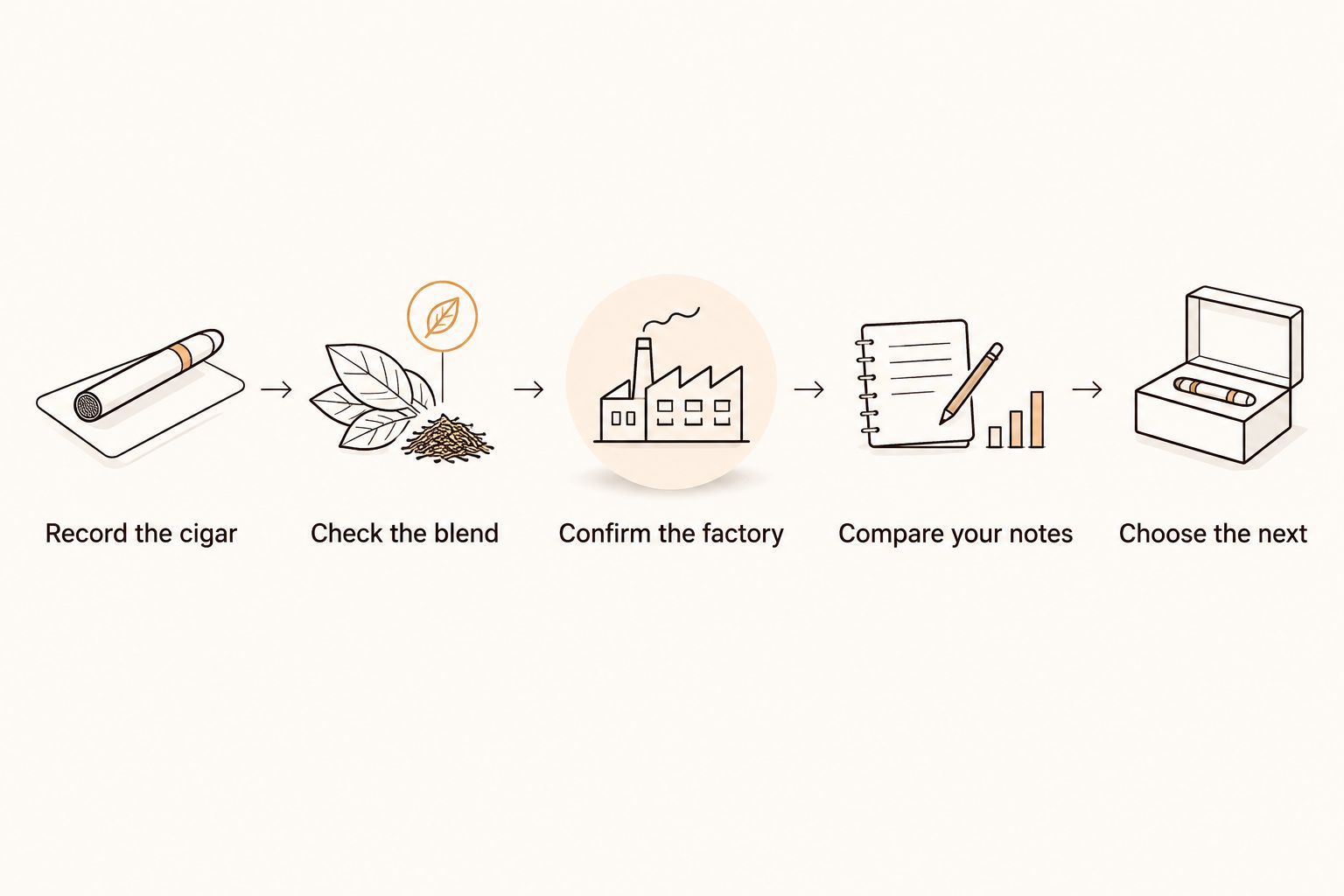
For your 2026 buying notes, use a repeatable sequence instead of collecting factory names without context. The goal is to identify what you enjoyed and which details support trying something related.
- Record the cigar. Write the exact brand, blend, and size. A brand name alone is too broad for a useful comparison.
- Check the blend. Record the disclosed wrapper, binder, and filler. Leave undisclosed components blank rather than filling them from memory or assumptions.
- Confirm the factory. Use an explicit manufacturer or retailer statement. Do not substitute the brand owner's location or the cigar's country of origin.
- Compare your notes. Separate flavor, body, strength, draw, and burn. Note storage or preparation issues that affected the experience.
- Choose the next comparison. Select a cigar that answers a specific question, such as whether you prefer a narrower format or a different wrapper.
A useful comparison question is specific: did you enjoy the format, the fuller body, or the way that particular cigar burned? “I liked that factory” bundles those observations together before you know which one mattered.
Keep the conclusion proportional to the evidence. Enjoying a cigar gives you a reason to investigate another production from the same factory—not a reason to assume you will enjoy everything it makes.
Two specification-led examples to examine
Crux Cigars Passport Super Selection 1 is best for examining cross-country tobacco sourcing; Rodriguez Cigars Serie 84 Maduro Robusto is best for examining a shorter, wider format. Both provide component and dimension details, but neither supplied description answers the factory question or states strength.
Use these examples to practice reading specifications, not as a claimed flavor match. Their published details support comparison; they do not support invented tasting notes.


Does the same factory mean the same flavor?
The same factory does not mean the same flavor. Different tobacco components and blend proportions prevent you from treating the production address as a recipe.
If you enjoyed a cigar, start with its exact blend and size. Then use a confirmed factory connection as an additional reason to investigate—not the entire recommendation.
Does a darker wrapper mean a stronger cigar?
A darker wrapper does not establish a stronger cigar. Wrapper appearance alone cannot tell you the nicotine intensity of the finished blend.
Check the stated strength separately and distinguish it from body or flavor intensity. When the description does not provide that information, ask before choosing on appearance.
Should I choose a sampler or a subscription to explore factories?
A sampler is best for a defined, one-time comparison; a subscription is best for recurring exploration. The sampler gives you a bounded selection, while a subscription requires you to manage an ongoing flow of cigars and keep useful notes.
Creekside Cigar Co.'s monthly Creekside Cigar Club is relevant to recurring exploration, but membership alone does not make each selection a controlled factory comparison. Check the current club details and ask how the selection fits your preferences.
Creekside Cigar Co. is best for adults exploring boutique cigars through a retailer offering individual cigars, samplers, and a monthly subscription. The choice between those formats depends on whether you want a specific experiment or continuing discovery.
FAQ
Can I tell a cigar's factory from its brand name?
A brand name alone does not confirm a cigar's factory. Look for an explicit statement identifying the manufacturing facility for that particular blend.
Does Nicaraguan origin mean all the tobacco is Nicaraguan?
Nicaraguan origin does not mean every tobacco component is Nicaraguan. Read the wrapper, binder, and filler disclosures separately from the manufacturing origin.
Is a boutique cigar automatically better than a big-name cigar?
The boutique label does not prove that a cigar is better for your preferences. Compare the specific blend, format, stated strength, and your experience rather than treating the label as a quality guarantee.
What should I ask when a cigar description leaves out the factory?
Ask who manufactures that exact blend and whether the information is confirmed. If it remains undisclosed, choose using the stated specifications rather than guessing from another cigar in the brand's range.
Should I blame the factory if my cigar burns unevenly?
An uneven burn alone does not establish a factory problem. Storage condition, lighting, smoking pace, and individual construction all deserve consideration before you draw a broader conclusion.
What should I record after trying a boutique cigar?
Record the exact blend and size, then separate flavor, body, strength, draw, and burn. Add the factory only when confirmed, along with any storage or preparation issue that affected your comparison.
One last thing
The most useful factory note is sometimes a blank space. If the manufacturer has not been identified, leaving it blank preserves the difference between what you know and what you assume.
For your next boutique cigar comparison in 2026, write down the exact cigar before reading another factory story. A precise record of what you enjoyed is more useful than a confident guess about who rolled it.


